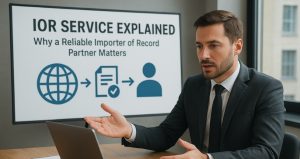
Booking air freight can move goods across borders, but it doesn’t establish who is accountable for export documentation and compliance. For California businesses shipping commercial goods or IT hardware, that distinction matters, particularly when the company has no legal entity overseas. An exporter of record California partner may support export administration, but freight coordination and EOR responsibilities are related, distinct needs.
Before appointing a provider, clarify who will handle each task and what remains your company’s responsibility. This guide explains when an Exporter of Record may fit your shipment and operating model, how the role differs from freight forwarding and the Importer of Record, and which transaction details to confirm. Use the scope and compliance checklist to assess whether a provider’s services match the goods, destination, and division of responsibilities for your shipment.
Key Takeaways
- Assess whether an exporter of record California service fits your shipment profile and operating model, especially if your business lacks an overseas legal entity.
- Map goods, destination, parties, and shipment details before confirming which export controls, filings, and documentation apply.
- Separate EOR administration from freight forwarding and internal export work. These responsibilities may complement one another rather than replace one another.
- Compare providers by confirming their shipment-specific scope, exclusions, documentation controls, escalation process, and reporting.
- Global4PL provides B2B EOR services for commercial goods and IT hardware, alongside commercial air freight coordination. Confirm the fit and responsibilities for each shipment.
Table of Contents
- Exporter of Record California: What the Role Means for B2B Shipments
- How Exporter of Record Responsibilities Fit the Export Compliance Workflow
- EOR, Freight Forwarder, or In-House Exporting: Compare the Operating Models
- How to Assess EOR Readiness and Select a Provider for California Exports
- How Global4PL Can Support California Businesses with EOR and Air Freight
Exporter of Record California: What the Role Means for B2B Shipments
An Exporter of Record (EOR) is a party appointed to carry out agreed export administration for a specific cross-border transaction. Its exact responsibilities depend on the shipment, applicable rules, and service agreement. The title alone doesn’t establish who prepares or submits documents, which party is identified in transaction records, or what obligations remain with the business. Confirm the scope before shipping.
A California company evaluating an exporter of record California service should start with its operating model, not assume every international shipment needs the same arrangement. Identify who will manage export-side administration, what the company can handle internally, and whether the provider’s role matches the goods and destination. Export requirements can involve controls such as the Export Administration Regulations (EAR). The rules and requirements relevant to a shipment depend on its specific facts.
When might a California business consider an EOR?
An EOR may be worth assessing when a business needs to send commercial goods abroad but has limited operational presence in the destination market to support the export process. For example, a company shipping IT hardware to an overseas business customer may need help administering export documentation while it focuses on its commercial relationship and internal operations. Other business goods may raise a similar operational question.
There’s no universal trigger. The fit depends on the goods, destination, exporter structure, parties involved, and transaction details. Support for one shipment type doesn’t confirm that every item or destination is eligible. Clarify the proposed scope for each transaction.
What an EOR does not automatically take over
An appointment covers only the tasks and responsibilities agreed for the transaction. It doesn’t automatically transfer every export-control, recordkeeping, or business obligation from the company. Establish who supplies accurate goods and transaction information, who reviews it, and which responsibilities remain internal. Written role definitions help prevent gaps and conflicting assumptions.
Export administration is also distinct from moving the shipment. An EOR role doesn’t automatically include freight forwarding, booking cargo space, coordinating carrier handling, or managing delivery. Confirm these separate needs independently. A business may arrange export administration and air freight through related but distinct services, or assign logistics tasks elsewhere. Before authorizing a shipment, document who handles each agreed task and where responsibility passes to the next party.
How Exporter of Record Responsibilities Fit the Export Compliance Workflow
A reliable export workflow moves from shipment facts to compliance review, agreed documentation responsibilities, and a clearly managed carrier handoff. Goods, destination, parties, and applicable rules can affect which controls or filings need assessment. Ask the provider to confirm its specific role rather than rely on a generic checklist.
For a business considering an exporter of record California service, a practical sequence is:
- Review the shipment: Gather an accurate goods description, destination, recipient, end use, and details of the transaction parties.
- Assess applicable requirements: Identify whether classification, licensing, or restricted-party screening needs review. The appropriate assessment depends on shipment-specific facts and applicable rules.
- Assign responsibilities: Document which tasks the exporter, EOR provider, and any freight forwarder will perform, including who supplies and reviews shipment information.
- Prepare and coordinate documents: Confirm who prepares, checks, and, where agreed, submits required commercial documentation or export filings.
- Handoff for transport: Align approved shipment information with the carrier arrangements and confirm how records and shipment updates will be handled.
What information should be reviewed before shipment?
Start with facts, not assumptions. A product description alone may not establish how an item should be treated for export purposes. Determine what information is needed to assess the goods, destination, recipient, end use, and other transaction parties. Classification, licensing, and restricted-party review are distinct assessment areas. Don’t assume a provider has made those determinations unless its scope says so and the appropriate party has reviewed the relevant facts.
How do documentation and freight handoff connect?
Commercial documents and export filing coordination support the shipment process, but the parties need to agree on who prepares, verifies, submits, and retains each record. Ask whether the provider’s role includes document preparation, review, filing coordination, record retention, or only specified administrative tasks. Confirm exclusions in writing.
Transport coordination is related to, but not interchangeable with, compliance review. Air freight arrangements may address scheduling and carrier handling; they don’t by themselves settle classification, licensing, or other compliance questions. An EOR provider, exporter, and forwarder can coordinate while retaining separate duties. Global4PL’s EOR administration and commercial air freight coordination may address both needs, subject to shipment-specific scope. Businesses assessing that fit can review Global4PL EOR and air freight services and confirm responsibilities before shipment handoff.
EOR, Freight Forwarder, or In-House Exporting: Compare the Operating Models
The right operating model depends on which tasks your business needs covered, not simply on whether it already has a freight forwarder. A forwarder may coordinate transport and carrier communication without taking on every export administration task associated with an EOR appointment. The roles can work together. Neither outsourcing nor appointing an EOR automatically removes the exporter’s other obligations.
Use this comparison as a starting point. Actual responsibilities depend on the written service scope and shipment details.
- Exporter of Record service: May handle defined export administration for an agreed transaction. Confirm which documents, filing coordination, reviews, and other tasks are included, along with the information and decisions the client must provide.
- Freight forwarder: May arrange or coordinate transport and carrier handling. Don’t assume transport booking includes export compliance determinations or all EOR responsibilities. Verify the forwarder’s contracted scope.
- In-house export operation: The company retains day-to-day control and assigns export tasks to internal staff. This can suit a business with established expertise and processes, but ownership must remain clear when a shipment, destination, or requirement changes.
A business might combine all three: internal staff supply and validate transaction information, an EOR provider performs agreed export administration, and a forwarder coordinates transport. The arrangement works only when handoffs and accountability are explicit. An EOR appointment doesn’t, by itself, establish that every company responsibility has transferred.
Which model fits your export operation?
Consider shipment frequency, internal export expertise, destination mix, and the company’s entity footprint. A business shipping occasionally to unfamiliar markets may assess external support for defined tasks, while a company with frequent shipments and experienced staff may prefer to retain more control. Limited in-country presence can also influence whether EOR support is useful. For an exporter of record California arrangement, assess the actual transaction and operating needs rather than assuming one model fits every exporter.
Partial outsourcing is another option to evaluate. Your team may retain ownership of product and transaction information while assigning specific administrative or transport tasks to external providers. Define those boundaries before the first handoff.
Questions that reveal service boundaries
Ask each provider who reviews documents, coordinates any agreed filings, and communicates shipment details to the carrier. Test the process for exceptions, too: Who follows up when information is missing or when goods, destination, or schedule changes? Request written confirmation of included tasks, exclusions, client inputs, and escalation contacts. Clear answers make it easier to compare the proposed service with your internal workflow and spot responsibility gaps before shipment.
How to Assess EOR Readiness and Select a Provider for California Exports
Provider selection is easier when your team first defines the shipments, responsibilities, and operating gaps it needs to address. California identifies the exporter context here, not a separate service-area claim. An exporter of record California search should lead to a shipment-specific assessment, not an assumption that a provider’s role or coverage applies to every transaction.
Use this checklist to prepare for provider discussions and compare proposals by scope rather than broad service claims.
Prepare a clear export-service brief
- Describe the shipment profile: Summarize the goods, destinations, recipient types, shipment cadence, and parties involved. Include current freight arrangements and any planned changes.
- Identify open compliance questions: List known questions about export controls, classification, licensing, or screening. Ask what the provider can assess within its agreed role and where it would refer you to another resource.
- Map internal ownership: Name the people responsible for approving shipments, supplying accurate product and transaction data, and resolving incomplete or changed information.
- Define the outputs you need: Specify which records, shipment updates, or reports your team requires, and how those outputs should support internal review and recordkeeping.
A concise brief helps distinguish recurring operational needs from a one-off shipment issue. It also gives providers the context to identify assumptions, dependencies, and questions to resolve before appointment.
Verify provider fit before appointment
Ask for a written description of the provider’s responsibilities for the relevant shipment profile. Check what it will prepare, review, coordinate, or report, and what remains your company’s responsibility. Confirm exclusions and client inputs explicitly. Broad phrases such as “export support” may not explain who handles specific tasks or what happens when information is incomplete.
Test the working process, too. Ask how the provider communicates shipment status, manages updates, and escalates exceptions such as missing data or a changed shipment. Confirm how documentation is controlled and what reporting your team can expect. Compare the responses with your internal approvals and existing freight arrangements. The aim is a clear operating boundary, not a promise that outsourcing eliminates every exporter obligation.
Once you’ve mapped your requirements, discuss your export requirements with Global4PL. Share the shipment profile and confirm the proposed EOR scope and any related air freight coordination for the specific transaction.
How Global4PL Can Support California Businesses with EOR and Air Freight
For a California-based business assessing an exporter of record California arrangement, provider fit depends on the shipment and the work to be covered. Global4PL provides Exporter of Record services for B2B international trade, including commercial goods and IT hardware. Its services may suit companies that need export administration but don’t have a local legal entity overseas. Eligibility and responsibilities depend on the transaction, so confirm the proposed scope before proceeding.
Global4PL’s export documentation and compliance administration are distinct from its commercial air freight coordination. Depending on the agreed scope, EOR administration may address export-side tasks, while air freight coordination relates to transport scheduling and carrier handling. These needs can connect operationally without one substituting for the other. Confirm who supplies information, reviews documents, coordinates each task, and retains any required records for the shipment.
Where Global4PL may fit the operating model
Global4PL may be worth evaluating if your company exports B2B shipments and needs export administration without establishing a local legal entity in the destination country. Commercial IT hardware and other business goods are relevant examples, but they don’t establish automatic eligibility. Review the goods, destination, parties, and transaction details, then confirm the provider’s responsibilities and exclusions for each shipment.
The service context is B2B trade operations. Global4PL’s EOR and air freight services should not be understood as consumer last-mile delivery. If your export workflow already includes a freight forwarder or internal export team, clarify how Global4PL’s agreed tasks would connect with those existing roles.
What to share when starting a provider discussion
Prepare a concise shipment brief so the scope can be assessed against the actual operating need. Include:
- Goods descriptions and destination
- Recipient, end-use information, and relevant transaction parties
- Expected shipment timing and cadence
- Current freight arrangements and internal process owners
- Known export questions and the documentation or coordination support you’re seeking
Use that discussion to establish which export responsibilities Global4PL can administer, which remain with your company, and whether commercial air freight coordination is also relevant. Clear assumptions and task boundaries make it easier to assess operational fit before a shipment is assigned.
To review your requirements and confirm whether the services fit your shipment or export program, contact Global4PL to discuss an export program.
Build a Clearer Path for Your Next Export
A sound export plan starts by assigning responsibilities before a shipment moves. Confirm the goods, destination, parties, and transaction details, then document which export administration tasks belong to your team and which a provider has agreed to handle. An exporter of record California service may fit some operating models, but confirm its scope for each shipment.
Keep transport coordination distinct from compliance administration. A freight provider may manage carrier arrangements without covering every EOR task, while an EOR appointment doesn’t automatically remove your company’s other obligations. Clear inputs, handoffs, and escalation expectations help prevent gaps.
Global4PL provides B2B Exporter of Record services for international trade and coordinates commercial air freight, documentation, scheduling, and carrier handling. These are related but distinct service scopes, so discuss your shipment profile and confirm responsibilities, assumptions, and exclusions before proceeding. Discuss your export requirements with Global4PL to explore whether the services align with your business needs. With a defined scope and operating model, your team can approach cross-border shipments with greater clarity.
Frequently Asked Questions
What does an Exporter of Record do for a California business?
An Exporter of Record handles export administration tasks agreed for a specific cross-border transaction. Depending on the service scope, this may include coordinating export documentation and compliance administration for a business shipment. The EOR’s title alone doesn’t define every responsibility or remove the company’s other obligations. Before shipment, confirm who supplies and reviews transaction information, which tasks the provider will perform, and what remains with the exporter.
Does a California exporter need an Exporter of Record?
No. A California exporter doesn’t automatically need an EOR for every cross-border shipment. Whether an exporter of record California service fits depends on the goods, destination, parties, company structure, and who can manage export administration. A business with limited overseas operating presence may assess EOR support for commercial goods or IT hardware. Confirm the provider’s shipment-specific responsibilities and applicable requirements before making an appointment.
Is an Exporter of Record the same as a freight forwarder?
No. An EOR appointment concerns agreed export administration, while a freight forwarder generally coordinates transportation-related tasks within its contracted scope. For example, a company might use one provider for EOR administration and a forwarder for air freight arrangements and carrier coordination. Services can complement each other, but don’t assume transport booking includes every export compliance task. Ask each provider to confirm its responsibilities, exclusions, and handoff points.
Can an Exporter of Record help a company export without a foreign legal entity?
Yes, an EOR service may support a company exporting internationally without its own legal entity in the destination country. Global4PL provides B2B EOR services for international trade, including commercial goods and IT hardware. This doesn’t mean every shipment or destination is automatically suitable. Confirm the goods, destination, parties, agreed administration, and any client responsibilities with the provider before relying on an EOR arrangement.
What documents may an Exporter of Record help coordinate?
An EOR provider may help coordinate export documentation within its agreed scope. Depending on the shipment, parties may need to address commercial documents and any applicable export filing requirements. The provider’s role could involve preparing, reviewing, or coordinating documents, but those tasks shouldn’t be assumed from the EOR title alone. Ask what records it will handle, what information your business must supply, and who retains documentation after shipment.
Who is responsible for export compliance when using an EOR provider?
Responsibility depends on the transaction, applicable rules, and written agreement. An EOR can administer defined export tasks, but appointing one doesn’t automatically transfer or eliminate every obligation held by the exporter or other parties. Clarify who supplies accurate product and transaction details, who reviews relevant information, and who handles required records. Document the allocation, and verify shipment-specific requirements with appropriate authoritative sources.
How do I evaluate an Exporter of Record provider for commercial shipments?
Start by sharing the goods, destination, recipient, end-use information, parties, shipment cadence, and current freight arrangements. Ask the provider to document its included tasks, exclusions, required client inputs, and responsibility for document review and filing coordination. Check how it communicates shipment status and escalates missing information or changes. Compare its proposed scope with your internal approvals and logistics workflow, and confirm fit for each shipment profile.